



SEO vs. GEO: Which path will your customers choose?
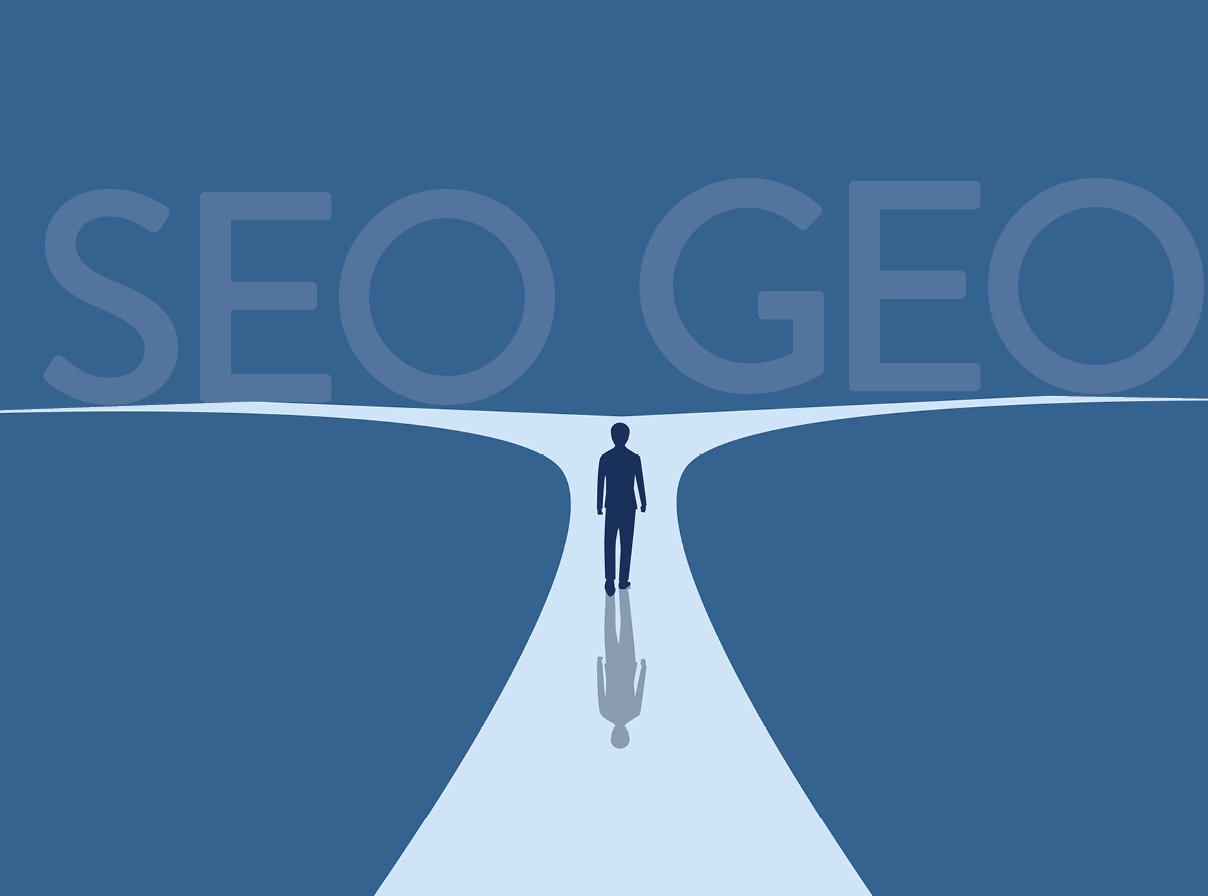
How do your B2B customers search for business-related information online? There are two primary paths they can take.
Many people enter a keyword or phrase and sift through the results. That path leverages the power of search engine optimization or SEO to get business web pages ranked by search engines such as Google.
For example, a busy university cafeteria manager might enter the phase: “campus foodservice prep savers.”
Based on a recent search, her SEO-driven results would include:
-
- A listing of food safety practices
- An article on ways to “get free food as a broke college student”
- Offers for foodservice training courses
- Meal delivery services for college students
- Guidance on tipping properly
All the results above are legitimate food-related resources. However, none of them focuses on the desired topic of prep saving tips.
Our cafeteria manager could refine her search and try again. Or she could get frustrated and abandon the search because her staff is stretched thin and she has no time to spare for fruitless surfing.
Now let’s consider the second path.
The alternative search option that is rapidly becoming a go-to for B2B decision makers is generative engine optimization or GEO (also called answer engine optimization or AEO).
To use this search method, our cafeteria manager would pose a specific question. For example, she might enter: “how can my foodservice staff save prep time?”
Based on a recent search, the GEO-driven results would include:
-
- Ways to streamline processes including batch prep, batch cook and simplifying prep
- Organization tips to help the foodservice kitchen better organize workstations, manage ingredients and separate food
- Ideas for improving workflow and planning including prep lists, task prioritization and cleaning tips
For this B2B search, the GEO results have proven to be far more relevant, pointed and actionable. The cafeteria manager now has multiple options she can employ and her search time feels much more rewarding.
Defining the different paths
What are the key differences between SEO and GEO?
Simply put, SEO focuses on ranking links in a list of search results, while GEO focuses on providing authoritative answers. But to better understand the nuanced differences, it pays to consider the objectives of each search method and how they work to accomplish those ends.
SEO goal: Grow business online by increasing leads, sales and revenue. This includes boosting organic traffic, improving keyword rankings, increasing click-through rates, enhancing conversions and improving user experience and engagement.
GEO goal: Have content appear as a direct source or citation within the AI’s synthesized, conversational answers. GEO involves structuring content clearly, ensuring it is authoritative and accurate, and optimizing technical aspects for AI parsing. That’s key, because AI search is growing and becoming a primary way users find information, making GEO a crucial strategy for future B2B visibility.
How to leverage GEO
To create GEO-optimized content for the web, you need to adapt your content for AI search engines. Here are some tips.
Write for human search and AI search
Be sure to use simple, clear language with short sentences. Paragraphs should also be concise and factual, containing approximately 2 to 4 sentences with 60 to 100 words total.
Use a question-and-answer format
Structure your content around a Q and A format answering pressing industry questions to improve the chances of appearing in AI answers for B2B searches. Be sure to answer the questions directly.
Use citable quotations
Incorporate quotations from trustworthy sources to make content more citable by AI models.
Establish your thought leadership
Build interlinked content around core themes to reinforce your expertise and position your company as the topical authority.
Keep it current
Regularly check AI-generated responses for your B2B brand to identify and fill content gaps and drive more traffic your way.
The right path
So, which path is best? For B2B brands, the short-term answer is both.
SEO is still the primary search option of B2B customers, so it should be incorporated into your content strategy. However, GEO-optimized content is emerging as a smart way for B2B brands to get found by both humans and AI. That’s because its results can prove more relevant for your target market.
In short, both paths are worth navigating because having multiple search strategies can lead more customers to you.